


What is an HR strategy?
An HR strategy is a plan that aligns human resource management with the overall goals of the business. It covers hiring, developing, and retaining employees in a way that supports growth and culture, ensuring you have the right people in the right roles at the right time.
In 2026, the stakes are higher than ever. According to Deloitte's Global Human Capital Trends survey, 7 in 10 business leaders say their primary competitive strategy is to be fast and nimble. Your HR strategy is the engine that makes that possible.
Why your HR strategy matters more than ever in 2026
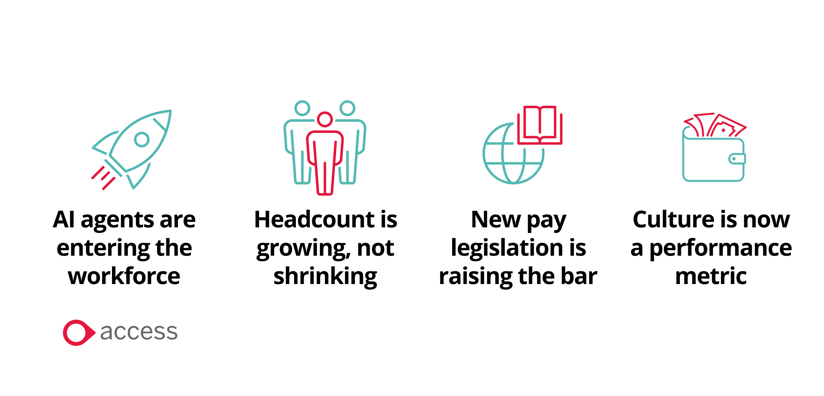
Four forces are reshaping HR strategy right now:
-
AI integration: More than half of talent leaders plan to add autonomous AI agents.
-
Workforce redesign: AI is replacing tasks, not people. 62% of organisations expect headcount to grow in 2026 as productivity gains free up capacity for new roles.
-
Pay transparency legislation: The EU Pay Transparency Directive entered into force on 7 June 2026, requiring employers to disclose pay ranges and report on gender pay gaps.
-
Culture and performance: Organisations that embed culture into daily work can see up to a 34% increase in employee performance.
How to build an HR strategy: 5 steps
- Define your objectives. Identify your business's long-term goals and how HR can help meet them. Break these down into specific, measurable targets aligned to your overall business plan.
- Assess your current position. Analyse workforce performance, satisfaction, and turnover. In 2026, also audit your AI readiness and pay equity position before gaps become liabilities.
- Set your KPIs. Choose metrics that align to your goals: turnover rates, satisfaction scores, internal promotion rates, and time-to-hire.
- Implement your strategy. Put plans into action with clear communication. Ensure managers and employees understand both the changes and the reasons behind them.
- Review and evolve. Revisit your strategy regularly. The organisations that thrive in 2026 and beyond treat change as a constant, not a disruption.
7 HR strategy examples for 2026
Now we’ve covered how to build HR strategies successfully, let’s share some solid HR strategy examples that should be considered.
1. AI-augmented talent acquisition
Recruiting leads AI adoption across all HR software categories, with an 81% utilisation rate. The shift toward skills-based hiring is accelerating alongside it: 85% of employers now use skills-based hiring, up from 81% in 2024, with over half having already removed degree requirements from at least some roles. 72% of employers agree that a holistic, skills-first approach leads to better hiring outcomes, and 94% of those using AI in hiring say it has brought measurable. The recruiting advantage in 2026 goes to teams that combine skills verification with AI-powered screening, moving quality checks earlier in the funnel.
2. Data-driven people analytics
Use people analytics to track engagement, predict turnover risk, and inform decisions with evidence rather than gut feel. Organisations that are effective at people analytics are over 5x more likely to integrate non-HR data and 6x more capable of acting on insights. Invest in HR software that surfaces actionable insights without requiring complex reporting skills.
3. Continuous learning and upskilling
Workers who feel supported to upskill are 73% more motivated than those who receive the least support, making access to learning one of the strongest predictors of motivation. Define clear development pathways and make learning owned by leaders, not just L&D teams.
4. Pay transparency and equity
The EU Pay Transparency Directive requires pay ranges in job adverts, employee access to pay information, and gender pay gap reporting. Companies with 250+ employees must report annually from 2027 using 2026 data. The burden of proof has shifted: employers must now prove no discrimination occurred, and an unjustified gap of 5% or more triggers mandatory remedial action. Audit your pay frameworks now and include ranges in all job postings and review your wider employee retention levers at the same time.
5. Leadership development for an uncertain world
82% of HR leaders plan to deploy agentic AI within the next 12 months, meaning leaders must now manage blended human-AI teams. Normalising change as part of the role results in a three times higher probability of healthy change adoption - build AI literacy into leadership programmes and create coaching frameworks that cascade from the top down.
6. Embedding culture to drive performance
Organisations that embed culture into daily processes, not just values statements, can see up to a 34% increase in employee performance. Use regular check-ins, anonymous feedback tools, and personalised development plans to keep employees connected and motivated. Spot disengagement early, before it becomes attrition.
7. Human-AI workforce redesign
HR is now responsible for decomposing roles into tasks, re-bundling work between humans and machines, and rethinking operating models. 88% of organisations now use AI in at least one function, yet nearly two-thirds have not begun scaling it across the enterprise - the gap between adoption and transformation is where value is being
How do organisations bring this all together?
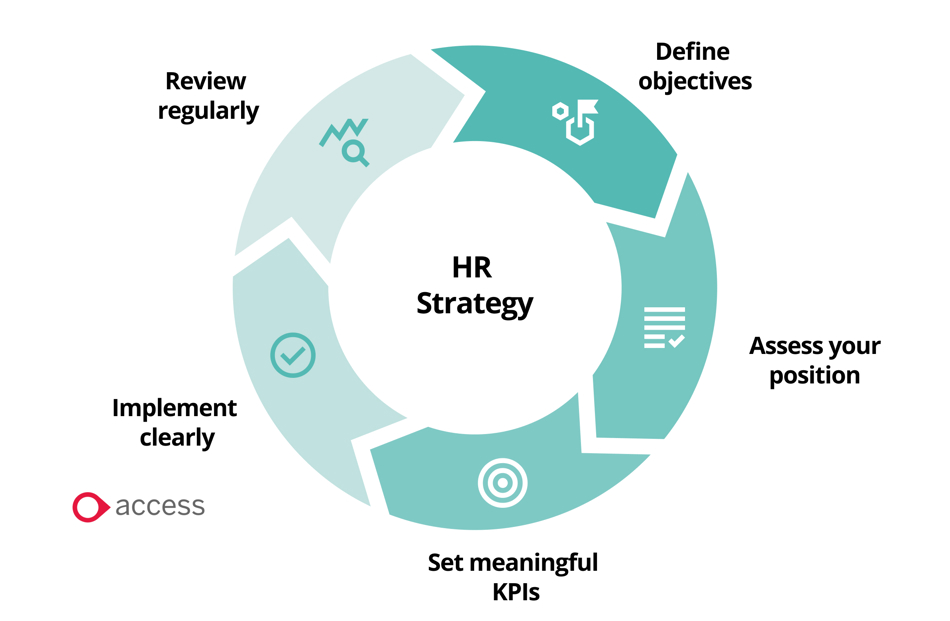 The most effective HR strategies in 2026 treat people and technology as complementary. They are grounded in data, aligned to business goals, and flexible enough to adapt as conditions change. Whether you're starting from scratch or refreshing an existing strategy, the steps are the same: define your objectives, assess your position, set meaningful KPIs, implement clearly, and review regularly.
How PeopleHR can support your HR strategies
Turning strategy into action requires the right tools. PeopleHR is HR software built for the demands of modern people teams - giving you a single platform to manage recruitment, performance, learning, and analytics in one place.
Whether you're rolling out skills-based hiring, tracking the impact of your L&D investment, or building the data foundation for workforce planning, PeopleHR removes the admin burden so your team can focus on what matters: your people. Watch a 4-minute demo to see how we can support your strategy or speak to our expert team.
