Contents
- Assessing the UK’s Payroll Anxiety
- Who is Included in the Report?
- The Impact of Payroll Inefficiencies
- The Majority of Workers Have Problems with Payroll
- One-Third of Employers Slow to Respond
- Employers Notice Just 1 in 5 Payroll Errors First
- Most Employees Only Experience Payslip Errors Once or Twice
- How Can Businesses Address Payslip Anxiety?
Anxiety over timely and accurate payroll has garnered greater attention in the post-pandemic years, amid historically high inflation rates that peaked at 11.1% in October 2022.
As inflation pushed everyday expenses for workers higher, the Bank of England’s (BoE) decision to hike interest rates to 5.25% in August 2023 pushed borrowing costs higher, causing the rate of repayments on mortgages and loans to increase.
Now, the UK Payslip Anxiety Report can quantify the impact of these newfound economic pressures on workers who experience issues in receiving correct and timely pay for the work that they do.
At a time when daily expenses and recurring repayments continue to stifle the financial comfort of the UK workforce, it’s becoming more important than ever for employers to seek to protect the wellness of their employees by adopting automation tools to ensure that staff receive their salaries without errors or complications.
Assessing the UK’s Payroll Anxiety
Key Findings
- Worryingly, 58.46% of employees have experienced a delay in receiving their payslip
- 63.85% claimed to have received incorrect pay during their employment
- 51.54% suggested that their payslip contained incorrect information
- 46.46% of those surveyed are experiencing anxiety over their pay
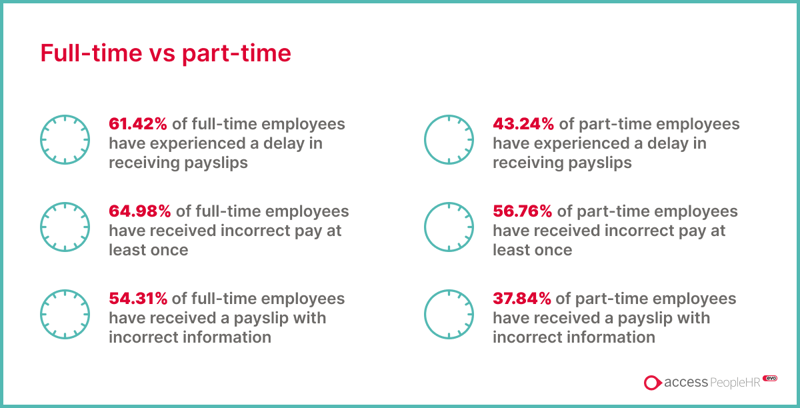
- 61.42% of full-time employees have experienced a delay in receiving payslips, compared to just 43.24% of part-time employees
- 64.98% of full-time employees have received incorrect pay at least once, compared to 56.76% of part-time employees
- Workers aged 18–24 have, in general, experienced a higher incidence of payslip delays and incorrect pay
- Workers aged 65+ have reported fewer delays, pay errors and inaccuracies in their payslips
- 16.62% of employees have lost sleep over payroll issues
- The IT sector leads the way in payroll delays, with 80.61% of employees reporting that they have experienced a delay in receiving their payslip at least once
- The report found that employees in Entry Level positions have experienced fewer payslip delays (39.29%) than those in the C-Suite (68.75%)
- 21.38% of workers have had to wait between three and five days to receive the correct pay, while 24.31% faced delays of more than a week
- The report also found that the impact of these inefficiencies has been profound, with 49.08% stating that they had feelings of unhappiness, and more than one quarter (27.08%) believing that they became disengaged or unmotivated at work as a result.
With 21.54% of surveyed employees suggesting that they were forced to borrow money because of payroll delays or errors, there’s also evidence that inefficiencies can cause workers to fall deeper into cycles of debt, with an elevated risk of falling into poverty.
Who is Included in the Report?
To ensure a fair level of representation within the UK Payslip Anxiety Report results, respondents were collected throughout a vast range of ages and sectors.
Demographics
By age, the report consists of 44 (6.77%) respondents aged between 18 and 24, 173 (26.62%) aged between 25 and 34, 184 (28.31%) between 35 and 44, 136 (20.92%) between 45 and 54, 93 (14.31%) between 55 and 65, and 20 (3.08%) aged 65 and over.
The report also features an even split between male and female respondents, with 319 (49.08%) identifying as female, 330 (50.77%) identifying as male, and one (0.15%) worker identifying as non-binary.
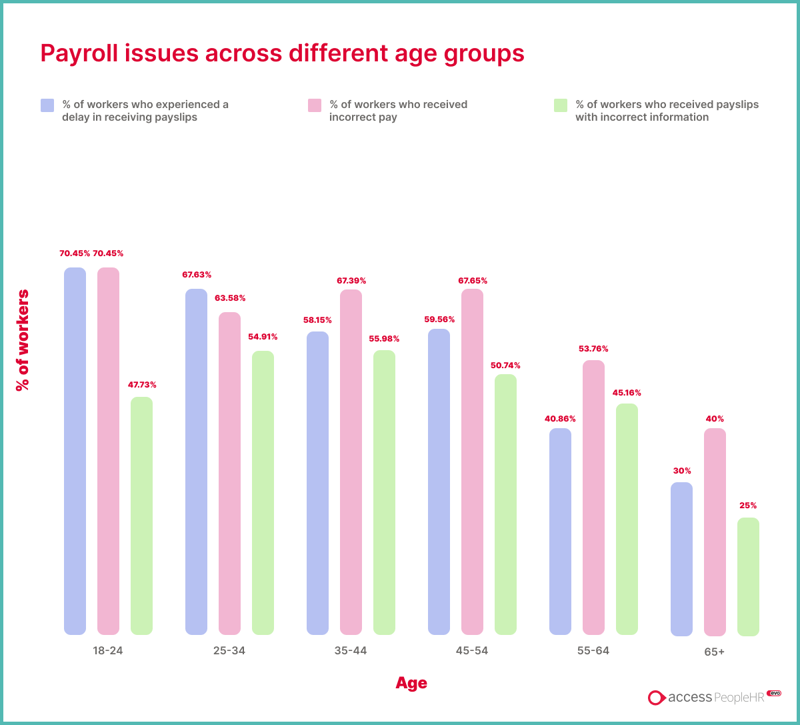
Workers aged 18–24 have, in general, experienced a higher incidence of payslip delays and incorrect pay. Specifically, 70.45% of workers in this age group have experienced a delay in receiving their payslips and have received incorrect pay at least once.
By contrast, workers aged 65+ have reported fewer delays, pay errors and inaccuracies in their payslips.
Employment Status
Respondents also spanned both full-time and part-time positions, which has helped the survey to deliver a fair reflection of paycheck stresses throughout different forms of employment.
With 532 (82%) of respondents stating that they are employed full-time, compared to 111 (17%) of part-time workers, the results of this report fairly reflect the general split between different types of employment throughout the United Kingdom.
Given that the report’s stratified sample reflects 78% of respondents in full-time roles, it offers a close reflection of the 76% of Britons aged between 16 and 64 who are in full-time employment, according to government data
Five respondents (0.77%) specified their employment status as ‘Other.’
Sector Coverage
To gain a comprehensive picture of payroll anxiety and how it spans different industries, insights have been compiled based on roles across 12 sectors, with the majority of those surveyed stemming from the IT industry (15%), healthcare (13%), and education (11%).
Other sectors that were represented included finance (9%), retail (9%), manufacturing (8%), administrative (6%), and hospitality (5%). 18% of respondents specified their industry as ‘Other.’
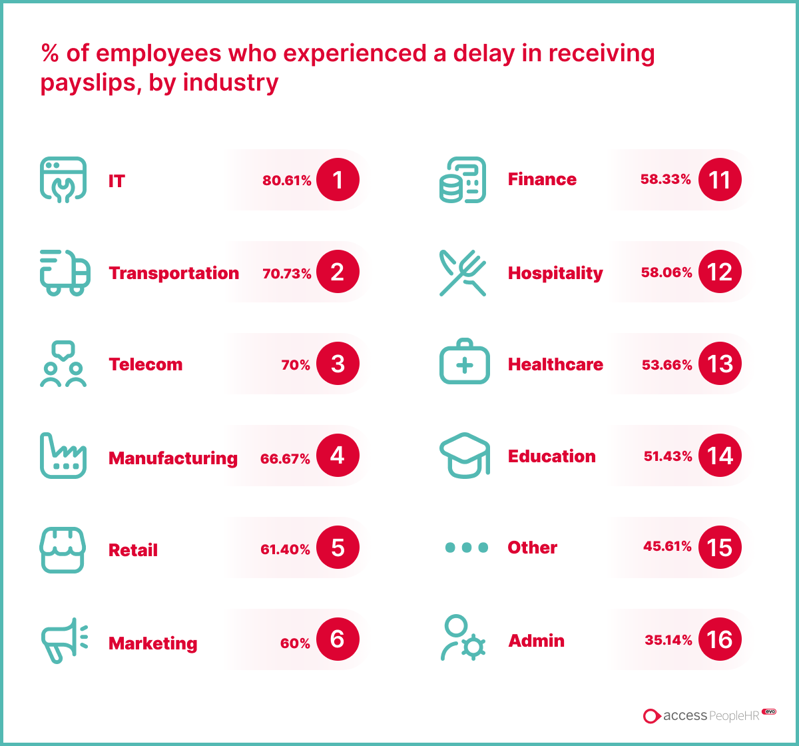
80.61% of those working in the IT industry have experienced a delay in receiving payslips at least once, compared to just 35.14% of those working in Admin.
Experience Level
While it’s reasonable to hypothesise that lower-income earners are more likely to experience payslip anxiety due to a lower level of financial comfort, this report sought to gain insights throughout a wide range of different income levels to ensure full representation.
With this in mind, 56 (9%) respondents stated that they were working in an entry-level role, 184 (28%) were intermediate-level, 144 (22%) were team leaders, 202 (31%) were managerial-level, and 64 (10%) were C-suite level.
The report found that employees in Entry Level positions have experienced fewer payslip delays (39.29%) than those in the C-Suite (68.75%).
Company Size
Variations in company size can help to indicate where payslip errors or delays are most likely to occur. While small businesses and startups are at a greater risk of inefficiency because of smaller dedicated HR teams focused on payroll, larger organisations are only as effective as the quality of their payroll software, with some using archaic systems becoming more prone to errors.
Of those responding to the survey, 18 (3%) were based in a small business of fewer than five employees, 45 (7%) were part of an organisation of between five and 25 workers, 145 (22%) in a company of between 25 and 100 employees, 131 (20%) in a larger firm of between 100 and 250 staff, 136 (21%) in an organisation of between 250 and 1,000 workers, and 175 (27%) in a major corporation of more than 1,000 employees.
Those working at companies employing between 100 and 250 people appear to have more payroll issues. 74.95% of employees reported a delay in receiving payslips and 70.23% have received incorrect pay at least once.
The Impact of Payroll Inefficiencies
The UK Payslip Anxiety Report has uncovered the extent of the psychological, social, productivity, and economic costs associated with inefficiencies throughout payroll among employers.
For many employers, payroll inefficiencies appear to be commonplace, which we will explore in more detail shortly, but their damaging effects on employees can harm workplace performance while causing significant damage to the wellness of employees due to the possible economic burden that delays or errors can create.
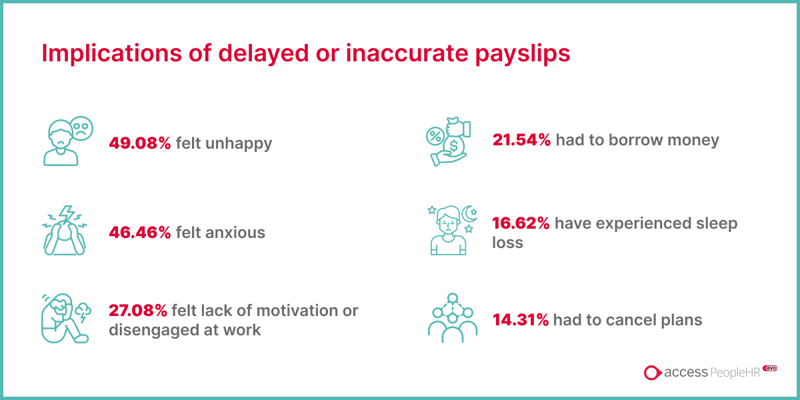
The report’s survey data shows that the majority of employees have experienced negative emotions and ramifications linked to various forms of payroll inefficiencies.
2.15% of employees had physical health concerns over payroll issues.
Half of Employees Have Experienced Unhappiness
In terms of the raw psychological impact of payslip issues, some 49.08% of UK employees have claimed that they’ve experienced unhappiness because of a delay or error in receiving their pay.
Worker unhappiness has become a major problem for employers, and there are links between discontentment at work and losses in productivity and more general disengagement when it comes to completing tasks on time.
More importantly, government data shows that more than 875,000 workers suffered from work-related stress, depression, or anxiety in the 2022-23 financial year, and our findings suggest that payslip inefficiencies can contribute to these negative feelings among workers.
Given that payroll inefficiencies are a preventable issue for employers, it’s clear that creating a more comprehensive system to deploy accurate payslips on time should be a priority for businesses that are prone to issues.
Payslip Anxiety is a Major Problem
In addition to unhappiness, more than 46% of respondents claimed that they have experienced anxiety due to payroll delays or errors.
2.15% of respondents have indicated that their physical health has been adversely affected by payroll worries, highlighting the extent to which anxiety over finances can cause tangible harm to those concerned about their commitments at a time when the cost of living is increasing.
To make matters worse, some 16.62% have suggested that their payroll challenges have caused them to lose sleep, which is another example of a physical health issue that can be prevented through better approaches to HR and handling employee pay.
Crucially, respondents were asked to specify the extent of their payslip anxiety on a scale of 1 to 5, with 5 being ‘very anxious.’
Just 29% of employees claimed that their anxiety levels over payslips were at a mild level below three out of five, while more than 40% described themselves as moderately to very anxious (4/5 and 5/5) regarding payroll inefficiencies.
31% believed that their level of anxiety over pay could be rated at a level of three out of five.
Negative Productivity Impacts
For employers, payslip anxiety can not only cause mental and physical concerns for employees, but it can also directly impact workplace productivity.
According to survey figures, 27.08% of employees have experienced a lack of motivation or disengagement at work, meaning that workers have been less likely to maintain high levels of productivity when completing daily tasks.
Precisely 8% of respondents have confirmed that they’ve missed a deadline at work as a result of payslip delays or errors. This data suggests that there could be economic incentives for onboarding more efficient payroll systems in terms of meeting deadlines and maintaining clients.
More than 11% of employees claimed that they’ve wanted to leave a company because of problems with their payroll, opening the door to the prospect of costly staff turnover due to preventable inefficiencies.
Finally, 4% have stated that they’ve taken time off work in the weeks that have followed a payslip delay or error, indicating that employers also risk losing productivity due to staff absences.
Counting the Social Cost
For employers who are mindful of empowering their workers to maintain a positive work/life balance, problems with payroll on the employee’s side can lead to steep social costs.
Our report found that 14.31% of respondents were forced to cancel their plans in either a social or work setting due to payslip errors or delays, which may perpetuate negative feelings towards wellness when it comes to life outside of the workplace.
According to data from People Management, more than two-thirds of employees feel that they can’t switch off from work or maintain a healthy work/life balance, and our insights show that payslip anxiety can be a contributing factor.
1 in 5 Risk Cycle of Deb
Perhaps the most damaging trend shown within the UK Payslip Anxiety Report is that almost 22% of respondents claimed that they have been forced to borrow money because of errors or delays in receiving their payslip.
This figure roughly correlates with the 21%, or 14.3 million, of individuals in the United Kingdom who are living in poverty and signifies the duty of employers to ensure that they are doing everything they can to protect their workers against living in a cycle of debt.
The recent cost-of-living squeeze on UK households saw the number of individuals struggling to pay bills and credit repayments soar from 5.8 million in 2020 to 10.9 million by 2023. Although figures are showing signs of calming, slipping to 7.4 million in January 2024, according to FCA insights, protecting employees against debt should be a priority for business decision-makers.
Given that 140 out of 650 survey participants have reported having to borrow to manage their financial obligations when payroll inefficiencies have impacted them, it’s clear that cycles of debt remain a constant threat to the workforce. If inefficiencies are left unaddressed, there’s a tangible risk that more employees could resort to high-interest payday loans or even exploitative loan sharks to address their debts.
The Majority of Workers Have Problems with Payroll
Across the three key questions our report asked surrounding the type of payroll inefficiencies experienced by employees, we found that the majority of workers had problems with their payroll in some form or another.
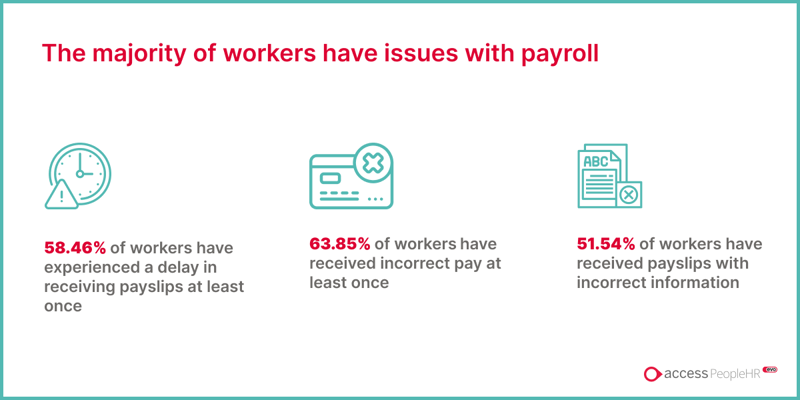
The most common mistake made stemmed from employees receiving the correct pay, of which 63.85% of respondents claimed that the wages they received had been inaccurate in the past.
Another frequent issue has been delays in receiving payslips, with 58.46% of employees suggesting that they haven’t had their salary paid on time.
Errors in the data recorded through payroll solutions are another common problem for employees, with 51.54% stating that they’ve noticed incorrect information recorded on their payslips.
These insights illustrate the scale of the task that employers of all sizes face when building efficiency in their payroll systems.
Given that most employees have not only received the incorrect pay in their salary packets but have also experienced delays and noticed incorrect information recorded, it’s clear that payroll inefficiencies pose multifaceted problems for HR teams to address.
One-Third of Employers Slow to Respond
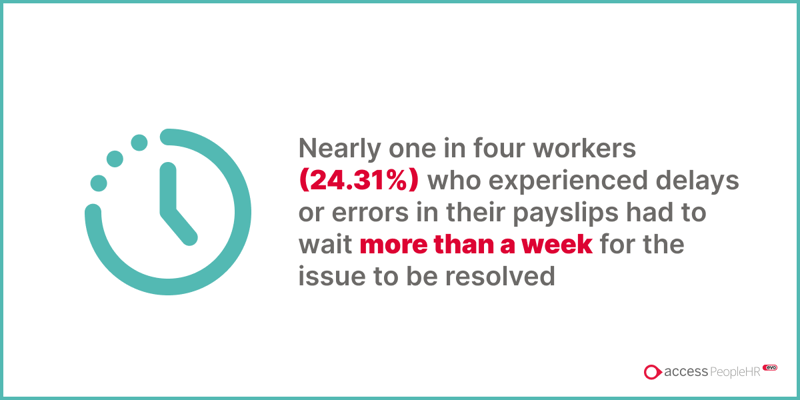
Correcting payroll errors is another key pain point for employees, with one quarter of errors taking more than one week to rectify.
Although 25.23% of respondents only needed to wait one day to receive the correct pay, a more common timeframe was two to three days, where 29.08% of employees were forced to go without the right payslip for.
21.38% of workers have had to wait between three and five days to receive the correct pay, while 24.31% faced delays of more than a week.
Waiting more than seven days to receive the right amount of pay risks leaving employees vulnerable to debts like bills and utilities without sufficient financial resources to make regular payments. The longer workers are left without pay, the more likely they are to borrow money to cover their financial obligations.
Employers Notice Just 1 in 5 Payroll Errors First
The burden of identifying payroll errors is often left to the employees themselves, with employers raising issues first just 20% of the time.
However, in most cases, workers only need to raise payslip issues once before they’re dealt with by the employer.
In 26% of cases where an issue is raised, employees have been forced to alert their employer twice or more, with 17% having to raise a problem twice, 5% raising it three times, and 4% requesting an issue be dealt with more than three times.
54% of the time, employees only need to raise a payslip issue once with their employer before the error is corrected.
Most Employees Only Experience Payslip Errors Once or Twice
Thankfully, although many employees experience payslip anxiety, 69% of respondents have dealt with payroll errors just once or twice.
This suggests that incorrect or delayed payslips are largely infrequent, but just one incident may be enough to prompt feelings of unhappiness or anxiety.
One quarter (25%) of employees have experienced payslip errors between three and five times, while 5% claim that errors have disrupted their pay six to 10 times.
2%, or 11, of the respondents to our survey stated that they have endured more than 10 payslip errors.
How Can Businesses Address Payslip Anxiety?
The UK Payslip Anxiety Report highlights the cost of shortcomings among employers when it comes to implementing a payroll system that’s prone to errors or delays in dispatching the correct pay for staff.
Because the majority of payslip errors stem from issues in manually collecting information and data entry, adopting automated payroll systems can be a critical way of improving accuracy when ensuring that workers are paid correctly and promptly.
Cloud-based payroll software can make it far easier for SMBs and larger organisations alike to pay employees in a fast, accurate, and affordable way while maintaining a high level of compliance.
Because these are automated solutions, they can speed up administrative processes for HR teams and provide a single source of truth for all employee data backed by data-rich visualisations.
Although there are some entry costs associated with payroll automation tools, these can be mitigated by higher worker productivity and lower employee turnover rates, as evidenced within our report.
Given that more than 15% of surveyed employees have taken days off following payroll errors or considered leaving their role, it’s clear that automation can immediately improve presence in the workplace while lowering the cost of onboarding replacement employees.
With 27% of respondents claiming that their motivation has been adversely affected by payslip errors, employers can take some measures to proactively address engagement challenges in the workplace.
Preventing Employee Anxiety
Looking after the wellness of employees should be a key consideration for employers, and any emphasis on supporting workers should extend to preventing feelings of payslip anxiety.
Even though our data shows that 69% of payslip errors happen just once or twice, it’s possible for businesses to prevent stress by opening a clear avenue for communication so that employees can quickly be assured should anything go wrong.
Whether decision-makers have a startup spanning four employees and outsourced payroll services or a multinational firm with a large in-house HR department, it counts for little if workers feel they are unable to communicate their concerns to the relevant parties if something goes wrong.
Because payroll automation software can create a self-service portal for employees, the tool can address feelings of payslip anxiety by implementing a greater level of transparency for workers.
Promoting an approachable culture for HR departments can be one strong solution when addressing payslip anxiety. Another positive approach is to support the financial wellbeing of workers by providing educational tools and advice.
By providing online links to helplines for those struggling with their financial wellbeing, such as Citizens Advice, which is available via a webchat and by phoning 0800 448 0826, or WhatsApp messaging +44 7701 342 744, more employees may be able to access the help that they need.
Methodology
Access PeopleHR conducted a nationwide survey spanning 650 respondents across businesses of all sizes and throughout a wide range of UK sectors to assess the full extent of payslip anxiety experienced by employees of all experience levels.
Conducted in November 2025, the data explores how frequently payslip errors occur for employees, the type of mistakes that are made, and their physical and psychological effects on workers.
Data correct as of November 2025.
You might also like: